How to Charge RC Car LiPo Batteries
Charge an RC car LiPo through both the main connector and the balance lead at 1C or less; a typical pack takes about 60 to 70 minutes at 1C, and should be stored around 3.8V per cell when not in use for a while.
Charging an RC car LiPo means feeding current back into the pack through a smart charger that reads each individual cell's voltage over the balance lead, not just the pack's total voltage.

Traxxas 2972 EZ-Peak Plus 100 Watt NiMH/LiPo Dual Charger
The Traxxas 2972 EZ-Peak Plus 100 Watt NiMH/LiPo Dual Charger with iD System reads Traxxas iD packs automatically, cutting out the manual cell-count step for anyone running Traxxas batteries and vehicles.
$129.95 listed price, changes often
Check price on AmazonWhy does an RC car pack need a balance lead connected?
Every hard-case RC car LiPo pack has two connectors: a main plug (Traxxas TRA, EC5, XT60, Deans, and so on) that carries the high current to and from the car, and a small balance lead with one wire per cell that lets a smart charger read and adjust each cell individually.
Charging through the main connector alone, without the balance lead, only measures total pack voltage, and a slightly weaker or stronger cell inside the pack can drift out of balance over repeated cycles without the charger ever knowing. Always plug in both connectors on a car pack, no exceptions, even on a quick top-off.
How long does it take to charge an RC car battery?
Charge time is set by the charge rate, expressed as a multiple of the pack's capacity, C. At 1C, the charge current in amps equals the pack's capacity in amp-hours, and a full charge takes about 60 to 70 minutes: roughly 60 minutes of raw charging plus 10 to 15 percent more time for the balancing phase at the end.
Charging faster than 1C shortens that time proportionally but adds heat and wear to the pack over its lifespan, which is why many RC car packs are only rated up to 2C or so for charging even when they can discharge at far higher C-ratings during a run.
| Charge rate | Charge current formula | Approx total time (with balance phase) |
|---|---|---|
| 0.5C (gentle) | Amps = pack mAh / 1000 x 0.5 | About 2 to 2.3 hours |
| 1C (standard) | Amps = pack mAh / 1000 | About 60 to 70 minutes |
| 2C (fast, if charger and pack both support it) | Amps = pack mAh / 1000 x 2 | About 30 to 35 minutes |
What does an iD charger actually do?
Traxxas iD packs carry a small chip in the connector that tells an iD-compatible charger the pack's cell count and chemistry automatically, so a charger like the EZ-Peak Plus can be set to just plug in and press the button, without you manually selecting 2S versus 3S or LiPo versus NiMH.
A non-iD charger, or a non-Traxxas pack, still charges fine, it just needs you to manually confirm cell count and chemistry before starting, which takes a few extra seconds and is easy to get wrong if you are not paying attention.
What voltage should I store an RC car battery at?
If a pack will sit for more than a few days between runs, charge or discharge it to about 3.8V per cell, called storage voltage, rather than leaving it at full charge (4.2V per cell). Storing at full charge for extended periods stresses the cells and shortens the pack's usable life over time.
Most smart chargers, including the iD models, have a dedicated storage mode that does this automatically. It is worth using every time a pack is going to sit for a while rather than get run again the same day.
What should I check before every charge?
Look the pack over for any puffing, swelling, or damage to the case before connecting it. A puffed pack should never be charged again; it has already suffered internal damage and can vent or catch fire under charge. Check that both the main and balance connectors are fully seated, and confirm the charger is set to the correct cell count and chemistry before pressing start.
Gear for this job
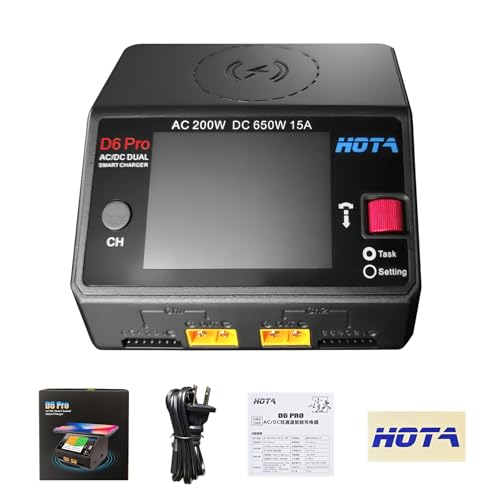 Best pick for mixed brands and faster 2C charging
Lipo Battery Charger RC Battery Charger HOTA D6 Pro Smart
The HOTA D6 Pro Smart Charger Dual Channel 15A AC200W is not locked to one brand's iD system and supports enough amperage to charge at 2C on larger packs, useful once you are running batteries from more than one manufacturer.
$104.99
View on Amazon Budget balance charger pick
LiPo Battery Charger RC Car Balance Charger
The LiPo Battery Charger 1S-6S Digital Discharger 80W 6A handles the basics, balance charging and discharging, at a lower price and lower wattage, meaning slower 1C-only charging on larger packs.
$39.99
View on AmazonGet this list emailed to you
Every pick on this page with its current price in one email, so you can decide later. One email, no sequence.
Frequently asked questions
How long to charge an RC car battery at 1C?
About 60 to 70 minutes for most packs, since 1C charging by definition takes roughly an hour, plus 10 to 15 percent more time for the balancing phase at the end. A 5000mAh pack and a 7200mAh pack both take about the same time at their own 1C rate, since the charge current scales with capacity.
Can I charge my RC LiPo without the balance lead?
You can charge through the main connector only if the charger explicitly supports balance-less charging, but it is not recommended for a car pack. Without the balance lead, the charger cannot see or correct individual cell voltages, and a pack that drifts out of balance over time becomes both less safe and shorter-lived.
What does an "iD" charger do differently?
An iD charger reads a small chip built into Traxxas iD battery connectors, automatically detecting cell count and chemistry so you can plug in and start charging with one button. Non-iD chargers work the same way electrically, they just require you to manually select those settings first.
Should I store my RC LiPo battery fully charged?
No. Storing a pack at full charge (4.2V per cell) for more than a few days accelerates cell aging. Charge or discharge to about 3.8V per cell, the standard storage voltage, using your charger's storage mode if it has one, before putting a pack away for a while.
Can I charge a 2S LiPo faster than 1C?
Some packs and chargers support 2C or faster charging, roughly halving the charge time, but this adds heat and shortens pack lifespan over many cycles. Only charge above 1C if both your specific pack and charger are rated for it, and never leave a fast charge unattended.
RCCarCalc is researched guidance, not professional advice. Figures come from published manufacturer specifications, listings and verified owner reports, not hands-on testing. Speeds are theoretical or as listed; real results depend on gearing, battery, tires and terrain. See how we research.