LiPo vs NiMH RC Car Batteries
A 2S LiPo like the HOOVO 2S 5200mAh 80C ($18.99) delivers 7.4V nominal at roughly half the weight of an equivalent-capacity NiMH pack, and holds its voltage much better under load. A 6-cell NiMH like the Tenergy 7.2V 3000mAh 6-Cell ($39.99) is heavier, has less usable capacity per dollar, but is simpler and safer to charge and store with no fire risk from physical damage.

HOOVO 7.4V 80C 5200mAh 2S Lipo Battery with TR Plug Hard Case
- 2S
- 5200mAh
5200mAh at 80C for $18.99, a strong first LiPo pack for a basher.
$18.99 listed price, changes often
Check price on AmazonLiPo has become the default battery chemistry in hobby-grade RC because it packs more energy into less weight and holds voltage steady under hard acceleration, both of which translate directly into speed and runtime. A 2S LiPo at 7.4V nominal is roughly equivalent in voltage to a 6-cell NiMH pack at 7.2V nominal, but the LiPo will sag far less under load, meaning the truck stays closer to full power throughout the run instead of gradually slowing down. NiMH's advantages are simplicity and safety margin: NiMH packs do not carry the fire risk that a physically damaged or improperly charged LiPo pack does, and NiMH chargers are simpler and cheaper. For a basher, short course truck, or anything performance-oriented, LiPo is the practical choice today. For an entry-level toy-grade truck, a young kid's first RC car, or anyone who wants to avoid learning LiPo-specific charging and storage rules, NiMH remains a reasonable, lower-risk option even though it is heavier and holds less voltage under load.
| LiPo | NiMH | |
|---|---|---|
| Nominal voltage per cell | 3.7V | 1.2V |
| Typical pack for a 2WD basher | 7.4V 2S, e.g. HOOVO 2S 5200mAh 80C $18.99 | 7.2V 6-cell, e.g. Tenergy 7.2V 3000mAh 6-Cell $39.99 |
| Weight for similar capacity | Roughly half the weight of an equivalent NiMH pack | Noticeably heavier for the same voltage class |
| Voltage sag under hard load | Minimal, stays closer to nominal voltage | Significant, power fades more noticeably as the pack depletes |
| Full charge voltage | 4.2V per cell | Approximately 1.4-1.5V per cell at full charge |
| Storage voltage/practice | 3.8V per cell for long-term storage | No specific storage voltage required, more tolerant of sitting at various charge levels |
| Charging complexity | Requires a balance charger and LiPo-specific settings | Simple, most basic chargers or wall-chargers handle NiMH safely |
| Fire risk if damaged | Real risk if punctured, overcharged, or short-circuited | Effectively no fire risk from physical damage |
| Cost for similar mAh | Lower cost per mAh at the low end, e.g. $18.99 for 5200mAh 2S | Higher cost per mAh, e.g. $39.99 for 3000mAh |
| Typical use today | Hobby-grade bashers, crawlers, race trucks | Toy-grade and entry-level trucks, some Traxxas completer packs |
LiPo
Lithium polymer, lighter and higher voltage-per-cell than NiMH, holds voltage well under load, requires specific charging and storage care.
Best for: Performance trucks, bashers, and anyone comfortable with LiPo-specific safety rules
HOOVO 7.4V 80C 5200mAh 2S Lipo Battery with TR Plug Hard Case
- 2S
- 5200mAh
$18.99 listed price, changes often
Check price on AmazonNiMH
Nickel-metal hydride, heavier and lower voltage-per-cell, simpler and lower-risk to charge and store, sags more under load.
Best for: Entry-level trucks, kids' first RC cars, and simpler charging needs
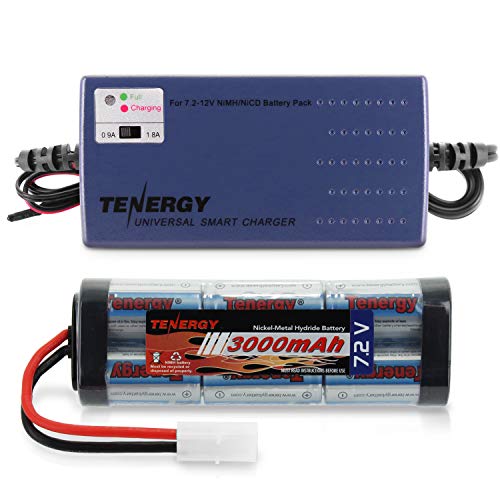
Tenergy 7.2V RC Battery Pack 3000mAh High Capacity 6-Cell NiMH
- 6S
- 3000mAh
$39.99 listed price, changes often
Check price on AmazonHow does LiPo voltage compare to NiMH?
LiPo cells are rated at 3.7V nominal, 4.2V at full charge, and should never be discharged under load below about 3.2-3.3V per cell (some ESCs cut off closer to 3.0V). A 2-cell (2S) LiPo pack is therefore 7.4V nominal. NiMH cells are rated at 1.2V nominal, so a common 6-cell NiMH pack lands at 7.2V nominal, close enough to a 2S LiPo that the two are often described as roughly equivalent in voltage. The real-world difference shows up under load: a NiMH pack's voltage sags more as current draw increases and as the pack depletes, so a truck running on NiMH will noticeably slow down over the course of a run in a way a similarly-rated LiPo pack will not.
Which battery gives better runtime?
Runtime in minutes works out to (mAh / 1000) times 0.8 usable capacity, divided by average amp draw, times 60. A 5200mAh 2S LiPo like the HOOVO 2S 5200mAh 80C running at an average draw of 15A works out to (5.2 x 0.8 / 15) x 60, or about 16.6 minutes. A 3000mAh NiMH pack like the Tenergy 7.2V 3000mAh 6-Cell at the same 15A average draw works out to (3.0 x 0.8 / 15) x 60, or about 9.6 minutes, notably less, both because of lower capacity and because NiMH voltage sag under the same load effectively reduces usable power before the pack is technically empty. Use the LiPo runtime calculator with your actual battery and truck's typical draw for a more precise number.
| Battery | Capacity | Runtime at 15A average draw |
|---|---|---|
| 2S LiPo 5200mAh (80C) | 5200mAh | ~16.6 minutes |
| 6-cell NiMH 3000mAh | 3000mAh | ~9.6 minutes |
| 2S LiPo 7200mAh (130C) | 7200mAh | ~23 minutes |
Which battery is safer to charge and store?
NiMH is the simpler and lower-risk chemistry by a wide margin. It does not carry meaningful fire risk from puncture, overcharge, or short circuit the way LiPo does, and most basic chargers, including simple wall chargers, handle NiMH safely without balance-charging concerns. LiPo requires real discipline: charge in a LiPo bag on a non-flammable surface, never charge unattended, store the pack at about 3.8V per cell rather than full charge for long-term storage, and never charge a pack that has developed a puff (visible swelling), which signals internal damage and a real fire risk.
This is the main reason NiMH still shows up in entry-level and kid-oriented trucks, including some Traxxas completer packs like the Traxxas Battery/Charger Completer Flat Pack with NiMH Battery at $70.25: it removes an entire category of safety rules a parent or first-time buyer would otherwise need to learn.
Which one should you buy?
For a hobby-grade basher, crawler, or anything performance-oriented, LiPo is the practical default today, more capacity per dollar, less weight, and voltage that holds up under load. The tradeoff is real: LiPo demands a balance charger, a fireproof storage bag, and attention to storage voltage. For a first RC car, a young kid's truck, or a buyer who wants to skip the LiPo learning curve entirely, NiMH remains a legitimate, lower-risk choice, even if it means less runtime and a heavier pack. Many hobbyists start on NiMH and move to LiPo once they are comfortable with the safety routine.
What to buy
Best NiMH starter pack
Tenergy 7.2V RC Battery Pack 3000mAh High Capacity 6-Cell NiMH
Simple, safe charging with a standard Tamiya connector at $39.99.
$39.99
View on Amazon Best higher-capacity 2S LiPo
OVONIC 2S LiPo Battery 7200mAh 7.4V 130C RC Battery with XT60
7200mAh at 130C for longer runtime on a hard-driving basher.
$49.99
View on Amazon Best LiPo safety bag to pair with any pack
Zeee Fireproof Explosionproof Lipo Bag Battery Storage(8.46 x
Fireproof storage bag at $13.49, non-negotiable for anyone charging LiPo indoors.
$13.49
View on AmazonGet this list emailed to you
Every pick on this page with its current price in one email, so you can decide later. One email, no sequence.
Frequently asked questions
Is a 2S LiPo the same voltage as a 6-cell NiMH?
Close but not identical. A 2S LiPo is 7.4V nominal, and a 6-cell NiMH is 7.2V nominal, a small difference. The bigger practical difference is that the LiPo holds that voltage much more steadily under load, while the NiMH pack sags more as current draw and depletion increase, so the LiPo will feel noticeably more consistent in power delivery throughout a run.
Can I charge a NiMH battery with a LiPo charger?
Many modern balance chargers, including several in this catalog, support both LiPo and NiMH charging modes, but you must select the correct chemistry and cell count on the charger before starting, since the charge profiles are different. Never assume a charger set to LiPo mode is safe for a NiMH pack or vice versa; check the charger's manual for supported chemistries.
Why is LiPo considered more dangerous than NiMH?
LiPo cells can catch fire if punctured, physically damaged, overcharged, or short-circuited, because of the chemistry's energy density and reactive electrolyte. NiMH does not carry this risk in normal use. That is why LiPo-specific safety practice, charging in a fireproof bag, never charging unattended, and storing at roughly 3.8V per cell, matters and NiMH does not require the same precautions.
Does NiMH last as long as LiPo per charge?
Generally no, for a comparable pack size NiMH typically delivers less usable runtime than LiPo, both because of lower energy density and because voltage sag under load effectively reduces available power before the pack is empty. Use the LiPo runtime calculator to estimate runtime for a specific pack and truck.
Should a kid's first RC car use LiPo or NiMH?
NiMH is usually the safer starting point for a young kid's first RC car, since it removes the LiPo-specific charging and storage rules a parent would otherwise need to supervise closely. As the kid gets more experienced (and older), moving to LiPo for better performance is a reasonable next step once the safety routine is understood.
RCCarCalc is researched guidance, not professional advice. Figures come from published manufacturer specifications, listings and verified owner reports, not hands-on testing. Speeds are theoretical or as listed; real results depend on gearing, battery, tires and terrain. See how we research.