Brushed vs Brushless RC Motors
Brushless motors are faster, more efficient, and need less maintenance; a basic brushed 540 motor like the INJORA 540 Brushed 35T runs about $13.98, while a comparable brushless combo like the GoolRC 3650 3500KV Brushless with 60A ESC runs $44.99. For bashing and racing, brushless is now the default. For dedicated rock crawling at walking pace, many drivers still choose brushed on purpose, more on why below.
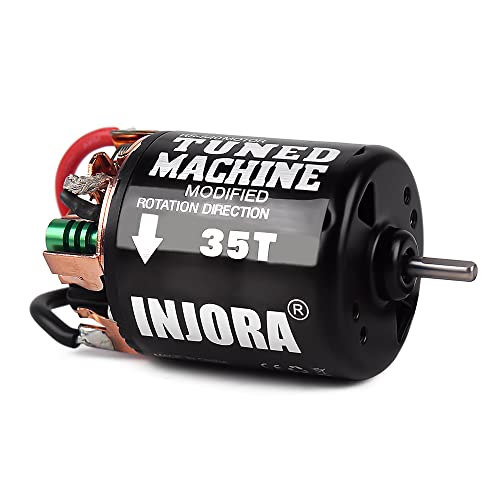
INJORA 540 Brushed Motor 35T Waterproof Motor for 1/10 RC
- 1/10
- Brushed
A proven 35T waterproof 540 at $13.98, the standard crawler swap motor.
$13.98 listed price, changes often
Check price on AmazonBrushless has replaced brushed as the default motor type in most of the hobby because it delivers more power per dollar of running cost, no brushes to wear out and replace, and higher efficiency that translates to longer runtime per charge. That said, "better" depends on the job. Brushless motors deliver their power in a way that is harder to modulate at very low, precise throttle inputs, exactly the control a rock crawler needs to walk over a ledge at a crawl. Brushed motors, especially high-turn (high-T) crawler-specific motors like a 35T 540, are easier to control with fine, linear throttle response at low speed, which is why a meaningful share of dedicated crawlers, including entry Traxxas TRX-4 Sport and Axial SCX10 III trims, still ship with brushed motors by design, not because brushless was too expensive to include. For speed, bashing, and racing, brushless is the clear pick. For crawling, brushed is a legitimate, deliberate choice, not a downgrade.
| Brushed | Brushless | |
|---|---|---|
| Basic motor price | $13.98-$19.97 (INJORA/HobbyPark 540/550 series) | $44.99-$95.98 for motor+ESC combos |
| Efficiency | Lower, more energy lost as heat | Higher, more of the battery's energy becomes motion |
| Maintenance | Brushes wear and eventually need replacement | No brush contact, effectively maintenance-free electrically |
| Top speed potential | Lower for a given voltage and gearing | Significantly higher at the same voltage and gearing |
| Low-speed throttle control | More linear and predictable at a crawl | Can be twitchier at very low throttle without a quality ESC |
| Heat under load | Runs hotter per unit of power delivered | Runs cooler for the same power output |
| Common use case | Entry-level bashers, dedicated crawlers, kid-oriented trucks | Mid-tier and flagship bashers, race buggies, speed trucks |
| Sensor option | Not applicable | Sensored (smoother low-speed control) or sensorless (cheaper, less smooth) variants exist |
| Example RTR truck | Redcat Volcano EPX 1/10 4WD Brushed $155.55 | Redcat Volcano EPX PRO Brushless $239.99 |
| Rebuild cost after wear | A new motor is often cheaper than diagnosing worn brushes ($15-20) | Rarely needs replacement, ESC failure is more common than motor failure |
Brushed
Simpler motor with physical brushes that wear over time. Cheaper, more linear low-speed control, still favored in dedicated crawlers.
Best for: Rock crawling and precise low-speed control
INJORA 540 Brushed Motor 35T Waterproof Motor for 1/10 RC
- 1/10
- Brushed
$13.98 listed price, changes often
Check price on AmazonBrushless
Sensor-based motor with no physical brush contact. More efficient, more power, less maintenance, the default for bashing and racing.
Best for: Speed, bashing, and general all-around use

GoolRC Upgrade Waterproof 3650 3500KV Brushless Motor with 60A
- 1/10
- Brushless
$44.99 listed price, changes often
Check price on AmazonWhy do brushless motors go faster than brushed for the same size?
Motor speed comes down to KV rating (RPM per volt) and how efficiently the motor converts battery current into rotation. Motor RPM equals KV multiplied by voltage, so a 3500KV motor on a 2S LiPo (7.4V) spins at roughly 25,900 RPM before gearing, and the same motor on 3S (11.1V) spins around 38,850 RPM, a jump of about 50 percent just from adding a cell. Brushless motors typically achieve higher KV ratings at higher efficiency than brushed motors of a similar physical size because there is no brush-to-commutator friction robbing power as heat. A comparable brushed 540 motor is usually rated by turns (like the 35T on the INJORA 540 Brushed 35T) rather than KV, and generally spins slower and runs hotter for the same battery input than a brushless motor of similar size.
That efficiency gap is also why brushless trucks tend to get more runtime from the same battery: less energy is wasted as heat in the motor itself, so more of it goes into moving the truck. Use the motor KV to RPM calculator to see the exact RPM math for any motor and voltage combination.
Why do so many rock crawlers still use brushed motors?
This is the detail that surprises a lot of newcomers: brushed motors are not simply the "budget" option in crawling, they are often the deliberate choice. Rock crawling rewards extremely fine, linear throttle control at very low speed, inching a tire up onto a ledge without spinning out. High-turn brushed motors (a higher turn count generally means lower speed and higher torque per amp) paired with a crawler-specific ESC tend to deliver smoother, more predictable low-end throttle response than many brushless setups, which can feel more abrupt off idle unless paired with a crawler-tuned sensored ESC.
That is why current RTR crawlers like the Traxxas TRX-4 Sport and the Axial SCX10 III Coyote 4X4 ship with brushed motors as the standard, purpose-built choice, not a cost-cutting measure, brushless crawler options exist (like the Redcat Ascent Fusion Brushless) but they are the upgrade path for crawlers who specifically want more power while still tuning throttle response, not the default recommendation for someone new to crawling.
How much more do brushless setups cost?
A basic brushed 540 or 550 motor in this catalog runs $13.98 to $19.97, and most RTR trucks that use brushed motors already have the ESC built in as part of the truck's electronics. A brushless motor and ESC combo, sold as a matched set because the two must be compatible, runs from about $44.99 for an entry combo like the GoolRC 3650 3500KV Brushless with 60A ESC up to $199.99 for a sensored crawler-specific combo like the Spektrum Firma 60A Brushless Smart ESC/2100Kv Sensored Motor Crawler Combo. As a rule of thumb, expect brushless to cost two to four times more than an equivalent brushed setup, a cost that is usually justified by higher speed, better efficiency, and less long-term maintenance.
| Setup | Price | Best for |
|---|---|---|
| Basic brushed 540 motor | $13.98-$19.97 | Crawler swaps, budget bashers |
| Entry brushless combo (sensorless) | $44.99-$53.99 | First brushless upgrade on a basher |
| Mid brushless combo (sensored) | $81.99-$133.99 | Smoother throttle control, crawler or basher |
| Crawler-specific sensored brushless combo | $179.99-$199.99 | Dedicated crawlers wanting brushless torque control |
Does a brushed motor wear out and need replacing?
Yes, brushed motors have physical carbon brushes that ride against a spinning commutator, and that contact wears down over time, especially under high current draw or high heat. Symptoms include reduced power, increased heat, or a burning smell. Because a full replacement 540 or 550 brushed motor costs as little as $13.98 to $19.97, most owners simply replace the motor rather than attempt a brush replacement, it is usually the cheaper and more reliable fix. Brushless motors have no brush-to-commutator contact and effectively do not wear out the same way; when a brushless setup fails, it is far more often the ESC than the motor itself.
Which one should you buy?
For a basher, short course truck, or anything meant to go fast, brushless is the better choice almost every time, more speed, more efficiency, less maintenance, and the price premium pays for itself in runtime and reliability. For a dedicated rock crawler, brushed is still a legitimate first choice, especially for a beginner, because the throttle control is more forgiving at a crawl. A crawler owner who later wants more torque and speed can upgrade to a sensored brushless crawler combo like the Spektrum Firma 60A Brushless Smart ESC/2100Kv Sensored Motor Crawler Combo without changing anything else on the truck.
What to buy
Best entry brushless combo
GoolRC Upgrade Waterproof 3650 3500KV Brushless Motor with 60A
Motor and ESC matched at $44.99, the cheapest way into brushless power.
$44.99
View on Amazon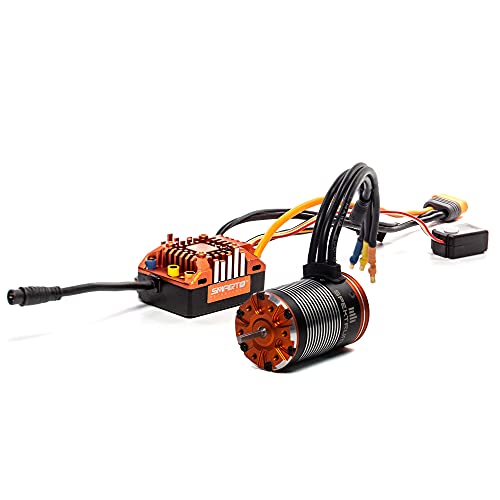 Best sensored crawler brushless combo
Spektrum Firma 60A Brushless Smart ESC / 2100Kv Sensored Motor
Built specifically for smooth low-speed torque control on a crawler.
$199.99
View on Amazon Best mid-power brushless upgrade
HOBBYWING Quicrun 10BL120 G2 & 3652SL G2 Combo (QR10BL120 G2
Hobbywing Quicrun combo at $89.99 for a noticeable step up from an entry sensorless setup.
$89.99
View on AmazonGet this list emailed to you
Every pick on this page with its current price in one email, so you can decide later. One email, no sequence.
Frequently asked questions
Is brushless always faster than brushed?
For the same voltage and gearing, yes, brushless motors are generally more efficient and reach higher RPM with less energy lost as heat. Actual top speed also depends on gearing and tires, so a well-geared brushed truck can still out-accelerate a poorly geared brushless one, but all else equal, brushless wins on speed.
Why do crawlers use brushed motors instead of brushless?
Rock crawling depends on fine, predictable throttle control at very low speed, and high-turn brushed motors paired with a crawler ESC tend to deliver smoother low-end response than many brushless setups. It is a deliberate design choice for control, not a cost-cutting shortcut, though brushless crawler combos exist for drivers who want more torque.
Do brushless motors need maintenance?
Far less than brushed motors. There are no brushes to wear down, so the motor itself rarely fails. The ESC (electronic speed control) paired with it is the more common failure point in a brushless setup, usually from heat, water intrusion, or a wiring short rather than normal wear.
Can I swap a brushed motor for brushless in the same truck?
Often yes, as long as the new motor and ESC combo match the truck's can size (commonly 540 or 550) and the truck's battery and gearing are appropriate for the added power. Check the specific truck's community forums or manual for known-good combos, and re-check gearing with the gear ratio calculator since more power on the same gearing can overheat the drivetrain.
What does sensored vs sensorless mean on a brushless motor?
A sensored motor uses internal sensors to tell the ESC exactly where the rotor is at all times, giving smoother, more linear throttle response, especially at low speed, which matters for crawling. A sensorless motor estimates rotor position electronically, which is cheaper to build but can feel less smooth off idle. Crawler-specific brushless combos are almost always sensored for this reason.
RCCarCalc is researched guidance, not professional advice. Figures come from published manufacturer specifications, listings and verified owner reports, not hands-on testing. Speeds are theoretical or as listed; real results depend on gearing, battery, tires and terrain. See how we research.