RC Crawler vs Basher
A basher like the Traxxas Slash 2WD Brushless ($329.95) is built for speed, jumps, and impacts on open ground. A crawler like the Traxxas TRX-4 Sport ($349.95) is built for low-speed, high-torque control over rocks, roots, and obstacles. They are not competing products, they are different hobbies that happen to both use RC trucks.

Traxxas Rustler 2WD Brushless 1/10 Scale Stadium Truck (Orange)
- 1/10
- 2WD
- Brushless
Brushless 2WD stadium truck at $299.95, easy to learn on and widely parts-supported.
$299.95 listed price, changes often
Check price on Amazon Full specsThe basher-versus-crawler question is really a question of what you want to do with the truck, not which one is "better." Bashers, whether it is a Traxxas Rustler, an Arrma Granite, or a short course truck, are geared for speed: low final drive ratios, brushless motors, and suspension tuned to survive jumps and impacts on flat or moderately rough ground. Crawlers, like the TRX-4 or Axial SCX10 III, are geared the opposite direction: high final drive ratios that trade speed for torque, solid axles that flex over uneven terrain, and motors (often brushed by design) tuned for slow, precise throttle control rather than acceleration. A basher will struggle to climb a rock ledge because it has neither the torque nor the axle articulation. A crawler will struggle to keep up on an open dirt lot because it is geared for maybe 5-10 mph, not 40. Most serious hobbyists eventually own one of each rather than trying to make one truck do both jobs.
| Basher | Crawler | |
|---|---|---|
| Typical top speed | 30-60+ mph depending on cell count and gearing | 2-8 mph, torque and control matter more than speed |
| Suspension | Independent, long-travel, tuned for jump landings | Solid axles front and rear, tuned for articulation over rocks |
| Gearing philosophy | High final drive ratio for speed | Low final drive ratio for torque |
| Common motor type | Brushless standard on most current models | Brushed common by design, brushless available as an upgrade |
| Entry price example | $339.99 ARRMA Granite 4x4 V3 BLX | $269.99 Axial SCX10 III Builder's Kit |
| Terrain | Dirt lots, pavement, jumps, open fields | Rock gardens, technical trails, obstacle courses |
| Battery demand | High discharge current for acceleration and top speed | Lower discharge current, runtime matters more than power |
| Typical damage risk | Broken suspension arms and driveshafts from impacts | Bent axles or stripped gears from binding on obstacles |
| Common upgrade path | Bigger cell count (2S to 3S or beyond), more aggressive tires | Portal axles, locked differentials, higher-torque motor |
| Search terms people use | "basher rc car", "bash truck" | "rc crawler vs basher", "basher vs crawler rc" |
Basher
Speed and impact-focused trucks: independent suspension, brushless power, high gearing, built for jumps and open terrain.
Best for: Speed, jumps, and driving on flat or moderately rough open ground

Traxxas Slash 2WD Brushless 1/10 Scale Short Course Truck (Red)
- 1/10
- 2WD
- Brushless
$329.95 listed price, changes often
Check price on Amazon Full specsCrawler
Torque and control-focused trucks: solid axles, low gearing, built to climb obstacles at walking pace.
Best for: Rock crawling, technical terrain, and slow, precise driving

Traxxas TRX-4 Sport 1/10 Scale 4X4 Crawler (Gray)
- 1/10
- 4WD
$349.95 listed price, changes often
Check price on Amazon Full specsWhat actually makes a truck a "basher" versus a "crawler"?
The split comes down to gearing and suspension design, not marketing labels. A basher is geared for speed: a relatively low final drive ratio (FDR) in the gearing sense means fewer motor revolutions needed per wheel revolution, so the wheels spin fast for a given motor RPM. A crawler is geared the opposite way, a high internal reduction inside the transmission means many motor revolutions are needed to turn the wheels once, trading speed for torque at the wheel. That is why a crawler can climb a steep rock face at a crawl without spinning out, while a basher with the same motor would simply spin its tires or flip over trying the same climb.
Suspension follows the same logic. Bashers use independent suspension tuned with stiffer springs and more travel to absorb jump landings without bottoming out. Crawlers use solid axles (or portal axles, which raise the axle centerline for more ground clearance) that allow one wheel to droop down into a gap while the opposite wheel stays planted on a rock, keeping traction on uneven terrain that would launch an independent-suspension basher off balance.
Can a basher be used as a crawler, or vice versa?
Not well, and this is the most common mistake for a new hobbyist to make. A basher's high gearing and independent suspension mean it lacks the low-speed torque and axle articulation to climb technical terrain, it will either stall out or flip trying. A crawler's low gearing means it physically cannot go fast, even wide open throttle on flat ground tops out at a walking-to-jogging pace, so using a crawler as a basher on an open dirt lot will feel slow and pointless by design, not because something is broken.
Regearing a basher toward crawler-style torque, or a crawler toward basher-style speed, is technically possible by swapping the pinion and spur gears (see the pinion and spur swap calculator), but suspension geometry does not change with a gear swap, so the truck will still handle like what it was built to be. Most experienced hobbyists keep one of each rather than trying to convert one truck into both roles.
How does cost compare between the two styles?
Entry prices are similar. A basher like the ARRMA Granite 4x4 V3 BLX starts around $339.99, and a dedicated crawler like the Axial SCX10 III Builder's Kit starts at $269.99 (electronics not included) or $349.99 fully RTR via the Coyote 4X4 RTR. Where the two diverge is in ongoing costs: bashers tend to consume batteries faster because high-speed runs draw more current, and crash damage from jumps and impacts is a routine cost of the hobby. Crawlers are gentler on batteries thanks to lower current draw at low speed, but the aftermarket upgrade culture (portal axles, locking differentials, scale accessories) can add up over time for a driver chasing more capability rather than speed.
Which one should a beginner start with?
For most first-time buyers, a basher is the more forgiving and more immediately fun starting point. It is easier to find open space to drive one (a dirt lot, a park, a driveway) than a genuine rock garden or technical trail, and the instant speed and jump capability is usually what draws people into the hobby in the first place. The Traxxas Rustler 2WD Brushless at $299.95 or the ARRMA Granite 4X4 Brushless at $339.11 are both reasonable starting points.
A crawler is the better first choice specifically for someone who already knows they want the slower, technical, obstacle-focused side of the hobby, often after seeing crawling videos or owning a basher first and wanting something different. The Traxxas TRX-4 Sport at $349.95 is a common, well-supported starting point for that path.
What to buy
Best beginner crawler
Traxxas TRX-4 Sport 1/10 Scale 4X4 Crawler (Gray)
Fully assembled RTR crawler at $349.95 with solid axles and low crawler gearing.
$349.95 specs
View on Amazon Best value basher upgrade
ARRMA 1/10 Granite 4X4 223S BLX BRUSHLESS RC Monster Truck RTR
4WD brushless power at $339.11 for a step up from a first 2WD basher.
$339.11 specs
View on Amazon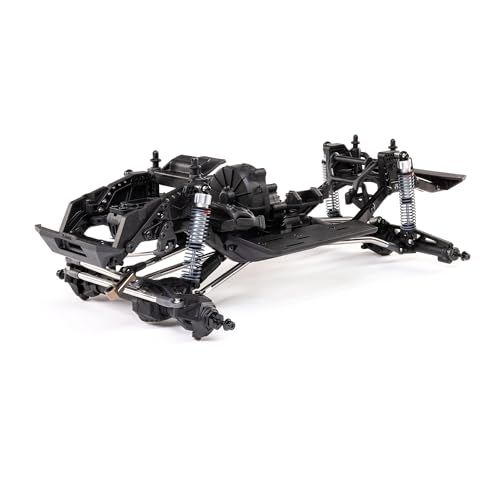 Best budget crawler build
Axial RC Crawler 1/10 SCX10 III 4WD Rock Crawler Builder's Kit
Builder's Kit at $269.99 for a hobbyist who wants to choose their own electronics.
$269.99 specs
View on AmazonGet this list emailed to you
Every pick on this page with its current price in one email, so you can decide later. One email, no sequence.
Frequently asked questions
What is the difference between a basher and a crawler?
A basher is geared and suspended for speed and impact, meant for jumps and open terrain. A crawler is geared and suspended for torque and control, meant for slow, precise climbing over rocks and obstacles. The two use fundamentally different gearing ratios and suspension designs, not just different bodies.
Can I use one RC truck for both bashing and crawling?
Not well. A basher lacks the torque and axle articulation to climb technical terrain, and a crawler is geared too low to go fast on open ground. Regearing changes speed but not suspension geometry, so most serious hobbyists own a dedicated truck for each style rather than trying to make one do both.
Which is more expensive to run, bashing or crawling?
Entry prices are similar between the two styles. Bashing tends to have higher ongoing costs from crash damage and faster battery consumption at high speed, while crawling tends to have lower per-run costs but can accumulate cost through aftermarket upgrades like portal axles and locking differentials.
Why do crawlers go so slow?
Crawlers use a much higher internal gear reduction than bashers, meaning many motor revolutions are needed to turn the wheels once. That trades speed for torque, which is exactly what is needed to climb a rock ledge at a controlled crawl rather than spinning out or flipping.
Is a basher or crawler better for a first RC truck?
A basher is generally the easier and more immediately fun first truck because it is usable on any dirt lot or driveway and rewards a new driver with instant speed. A crawler is a better first truck specifically for someone who already wants the slower, technical, obstacle-focused side of the hobby.
RCCarCalc is researched guidance, not professional advice. Figures come from published manufacturer specifications, listings and verified owner reports, not hands-on testing. Speeds are theoretical or as listed; real results depend on gearing, battery, tires and terrain. See how we research.