How Fast Do RC Cars Go?
Most RC cars land between 10 and 50 mph depending on class: toy-grade trucks typically run 10 to 25 mph, entry-level brushless bashers like the GAMRUXI 1:16 Brushless RC Car at $122.99 are advertised around 50+ mph, and dedicated 6S and 8S speed platforms carry manufacturer-advertised claims well past 80 mph.
An RC car's top speed is the wheel rotation rate translated into forward distance per minute, which makes it a function of motor RPM, gearing, tire size and voltage together, not any single spec on its own.

GAMRUXI 1:16 Scale Brushless RC Car - 50+ MPH High Speed All
- 1/16
- Brushless
- 50 mph listed
A 1/16 scale brushless car advertised at 50+ mph, with the speed claim stated directly on the listing rather than left vague, and priced well under $150.
$122.99 listed price, changes often
Check price on Amazon Full specsWhat top speed should you expect by RC car class?
These are typical ranges, not guarantees for any single car. Real speed depends on gearing, tire diameter, surface, and battery condition as much as the class the car falls into. For anything in the 6S to 8S range, only trust the manufacturer's own advertised figures; nothing in this catalog has been independently tested by us for top speed.
| Class | Typical top speed | Example use |
|---|---|---|
| Toy grade | 10-25 mph | Preassembled toys for young kids |
| Entry-level brushed hobby grade | 15-25 mph | First hobby-grade RTR trucks |
| Entry-level brushless (2S-3S) | 30-50 mph | Budget speed bashers |
| 4S-6S brushless bashers | Often advertised 50-70 mph | Short course trucks, monster trucks, buggies |
| 6S-8S dedicated speed platforms | Manufacturer claims of 80-100+ mph | Purpose-built speed-run cars |
What is the math behind an RC car's top speed?
Top speed starts with the motor: RPM equals KV multiplied by voltage. That RPM then passes through the final drive ratio (FDR), which is the spur-to-pinion ratio multiplied by any internal transmission or differential ratio, to give wheel RPM. Wheel RPM, tire diameter, and a constant to convert to miles per hour gives you a theoretical top speed: mph equals wheel RPM times tire diameter in inches times pi times 60, divided by 63,360.
Real-world speed is usually only 80 to 90 percent of that theoretical number, because of drivetrain friction, aerodynamic drag, rolling resistance, and voltage sag under full load. See motor KV explained for how KV itself is chosen.
Why don't manufacturers always market the fastest possible number?
Advertised top speeds usually represent a best-case run: a flat, hard surface, a fresh fully charged pack, and the stock pinion-and-spur combination the factory shipped. Terrain, tire wear, driver skill, and a battery that has already lost some capacity all pull real-world speed below that number. Treat a manufacturer's stated top speed as a ceiling under ideal conditions, not an average you should expect every run.
Does cell count (2S vs 3S vs 6S) directly control top speed?
Largely, yes, because voltage feeds straight into the motor RPM formula. Moving from 2S (7.4V nominal) to 3S (11.1V nominal) is roughly a 50 percent jump in voltage, and if gearing and motor KV stay the same, RPM rises by close to that same percentage. That also raises current draw and motor heat, which is why cars built around higher cell counts are usually paired with a lower KV motor rather than the same motor just fed more volts. Compare the tradeoffs directly at 2S vs 3S LiPo.
How do you safely change your own car's top speed?
Gearing is the most direct lever: a larger pinion or smaller spur raises the final drive ratio for more top speed, at the cost of acceleration and extra motor heat. See how to change a pinion gear and check the numbers first with the gear ratio and top speed calculator. Moving up in cell count or motor KV also raises top speed, but both raise current draw, so keep an eye on motor temperature with the motor temperature guide any time you push a car faster than stock.
What is a dedicated speed-run RC car, and is it different from a fast basher?
Dedicated speed-run platforms are built specifically to chase a top-speed number on a flat, straight surface, using an oversized pinion, a body designed for low drag, and tires meant for pavement rather than dirt. Manufacturers of these platforms advertise figures well north of 100 mph. They are not bash-friendly all-rounders: they typically need a specific surface, a break-in procedure for the drivetrain, and are far less durable in everyday driving than a basher truck built for jumps and rough terrain.
Estimating top speed for a 4300KV motor on 2S
- Motor RPM = KV x volts = 4300 x 7.4V (2S nominal) = 31,820 RPM.
- Gearing: an 87-tooth spur over a 19-tooth pinion gives a spur/pinion ratio of 4.58. An internal transmission ratio of 2.6:1 gives a final drive ratio (FDR) of 4.58 x 2.6 = 11.9.
- Wheel RPM = motor RPM / FDR = 31,820 / 11.9 = 2,674 RPM.
- Using a 4.6 inch tire diameter: theoretical mph = 2,674 x 4.6 x pi x 60 / 63,360 = about 36.6 mph.
- Real-world speed at 80-90 percent of theoretical lands around 29 to 33 mph, which is in line with what several 2S-3S entry brushless bashers in this class actually advertise.
Gear for this job
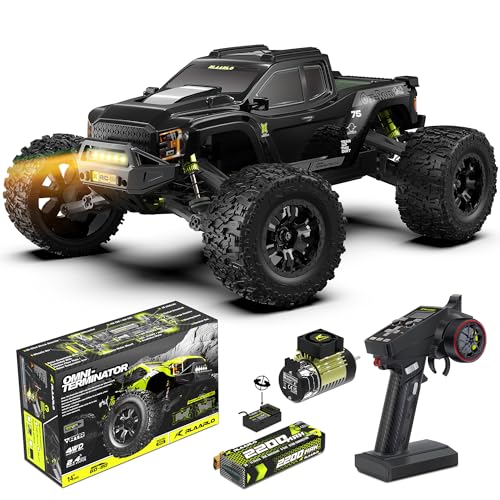 Best 1/10 scale fast basher
RIAARIO 1/10 Brushless RC Cars
A 1/10 scale, 4WD, waterproof, carbon-fiber-reinforced brushless car advertised at 50+ mph. A bigger chassis than the mini-scale options, with more room to grow into upgrades.
$249.99 specs
View on Amazon Best fast RTR that comes with backup batteries
UDIRC 1/14 Brushless RC Cars
A 1/14 scale, 4WD brushless truck advertised at a max of 40 mph, and it ships with three batteries, so you spend more of your time actually running at speed instead of waiting on a charger.
$129.99 specs
View on Amazon Best fast car for drift-style driving
DIKAVEY 1:12 RC Rally Car Fast Max 50 MPH
A 1/12 scale rally-style car advertised at a max of 50 mph, built around a drift chassis rather than a straight-line basher, if sliding matters as much to you as raw speed.
$136.99 specs
View on AmazonGet this list emailed to you
Every pick on this page with its current price in one email, so you can decide later. One email, no sequence.
Frequently asked questions
What is the fastest RC car you can buy?
Dedicated speed-run platforms, built specifically to chase a top-speed number on a flat, closed surface, are advertised by their manufacturers well past 100 mph. These are not general-purpose bashers: they typically need a specific surface, careful break-in, and give up the durability a jump-and-bash truck needs.
Is 30 mph fast for an RC car?
Yes, for most entry-level and toy-grade classes. Toy-grade trucks usually run 10 to 25 mph, and entry-level brushed hobby-grade cars land in a similar range, so a car doing a genuine 30 mph is already outrunning most of the toy and entry-brushed segment, even though it is modest compared to a 6S or 8S basher.
Do all RC cars list a top speed?
No. Many toy-grade and lower-priced hobby-grade cars do not state a top speed at all, while entry-level brushless bashers and speed-focused platforms very often lead with it as a headline spec, since it is one of the main selling points for that class of car.
Why is real-world RC car speed slower than the calculated number?
The theoretical top speed formula assumes a perfect, frictionless drivetrain and a battery holding full voltage under load, neither of which is true in practice. Drivetrain friction, aerodynamic drag, rolling resistance, and voltage sag under full throttle typically bring real-world speed down to about 80 to 90 percent of the theoretical number.
Does a bigger battery make an RC car faster?
A bigger capacity (mAh) battery mostly buys you longer runtime, not more speed. What actually raises top speed is higher voltage, meaning more cells in series (2S to 3S to 4S and so on), since motor RPM scales directly with voltage for a given KV and gearing. A higher C-rating on the battery matters for sustaining current under load, but capacity alone does not increase top speed.
RCCarCalc is researched guidance, not professional advice. Figures come from published manufacturer specifications, listings and verified owner reports, not hands-on testing. Speeds are theoretical or as listed; real results depend on gearing, battery, tires and terrain. See how we research.